
Understanding Superannuation Rates and Thresholds in Australia (2025–26): Your Ultimate Guide
Australia’s 2025–26 superannuation rates and thresholds affect how much you can contribute, how your super is taxed, and which government incentives you can access. This guide explains contribution caps, SG rates, tax thresholds, and practical planning strategies to help you maximise retirement outcomes.
Table of Contents
- Introduction: Navigating the 2025–26 Superannuation Landscape
- Contributions Caps: The Core Limits
- Superannuation Guarantee (SG): Your Employer’s Contribution
- Tax Thresholds You Should Know
- Government Incentives for Low-to-Middle Income Earners
- Other Important Super Thresholds
- Planning Tips: Maximising Your Nest Egg in 2026
- How NetGrowth Helped: Using Carry- Forward Contributions to Build More Super
- Conclusion: Partnering with NetGrowth for Strategic Retirement Planning
Introduction: Navigating the 2025–26 Superannuation Landscape
Superannuation remains one of the most powerful tools Australians have for building long‑term retirement wealth. Yet, contribution caps, tax thresholds, and eligibility rules continue to evolve. With the 2025–26 financial year now in effect, reviewing the latest superannuation rates and thresholds is essential to ensure you’re contributing efficiently, minimising tax, and taking advantage of available incentives.
Why Rates and Thresholds Matter
Concessional Contributions Cap (2025–26)
Concessional contributions are before‑tax contributions, including:
- Employer Superannuation Guarantee (SG)
- Salary sacrifice
- Personal deductible contributions
These are taxed at 15% inside super, often lower than personal income tax rates. 2025–26 concessional cap: $30,000
If you exceed this cap, additional tax may apply unless you’re eligible for thefive‑year carry‑forward rule.
Carry‑forward rule:
If your total super balance was below $500,000 at 30 June of the previous year, unused concessional caps from the past five years can be used.
Category | Details |
|---|---|
Annual Cap | $30,000 |
Tax Rate in Super | 15% |
Includes | Employer SG, salary sacrifice, personal deductible contributions |
Carry-Forward Rule | Unused cap available for up to 5 years |
Eligibility for Carry-Forward | Total super balance < $500,000 (as at 30 June previous year) |
Excess Contributions | May incur additional tax |
Non‑Concessional Contributions Cap (2025–26)
Non-concessional contributions are made from after-tax income and don$apos;t provide an upfront tax deduction.
Annual cap: $120,000
Bring-forward rule: Up to $360,000 over three years (if under age 75)
Your ability to contribute may be reduced or eliminated if your total super balance exceeds legislated thresholds.
Category | Details |
|---|---|
Annual Cap | $120,000 |
Bring-Forward Rule | Up to $360,000 over 3 years |
Eligibility | Under age 75 |
Tax Treatment | No tax on entry (already taxed income) |
Restrictions | Reduced or nil if total super balance exceeds thresholds |
Purpose | Boost retirement savings without claiming tax deduction |
Superannuation Guarantee (SG): Your Employer’s Contribution
One of the most important numbers for many workers is the Superannuation Guarantee rate — the percentage of your ordinary earnings your employer must contribute to your super.
From 1 July 2025, the SG rate rose again to 12% of ordinary time earnings. This increase marks the final stage of a phased rise that began several years ago, and it applies to most employees in the workforce.
There’s also a limit called the Maximum Superannuation Contribution Base (MSCB). It caps the amount of earnings on which SG contributions must be paid. If you earn above the MSCB in a quarter, your employer doesn’t need to contribute SG on earnings above that limit. For 2025–26, the quarterly MSCB is $62,500, equating to a maximum SG contribution of $7,500 per quarter.
Key Superannuation Tax Thresholds You Should Know
▼ Division 293 Tax
If your income plus concessional contributions exceeds $250,000, an extra 15% tax applies to the portion above the threshold.
This effectively doubles the contributions tax to 30% for high-income earners, making proactive planning essential.
Government Incentives for Low-to-Middle Income Earners
Super Co-Contribution Scheme
Eligible individuals making after-tax contributions may receive:
- 50 cents per $1 contributed
- Up to $500 per year
The benefit phases out as income increases.
Low-Income Super Tax Offset (LISTO)
LISTO ensures low-income earners aren't disadvantaged by the 15% contributions tax.
- Income threshold: $37,000 or less
- Refund: Up to $500 paid directly into super
Other Important Superannuation Thresholds
Transfer Balance Cap
The transfer balance cap limits how much super can move into the tax-free retirement phase.
2025–26 cap: $2 million
▼ Capital Gains Tax (CGT) Cap
For small-business owners selling assets: CGT cap: $1,865,000 (2025–26)
Allows higher contributions without breaching non-concessional limits
Planning Tips: Maximising Your Super in 2026
To optimise your superannuation strategy:
- Track annual contributions against caps
- Monitor your total super balance
- Use carry-forward contributions strategically
- Check eligibility for co-contributions and LISTO
- Review Division 293 exposure annually
Proactive planning prevents penalties and accelerates retirement growth.
How NetGrowth Helped: Using Carry- Forward Contributions to Build More Super
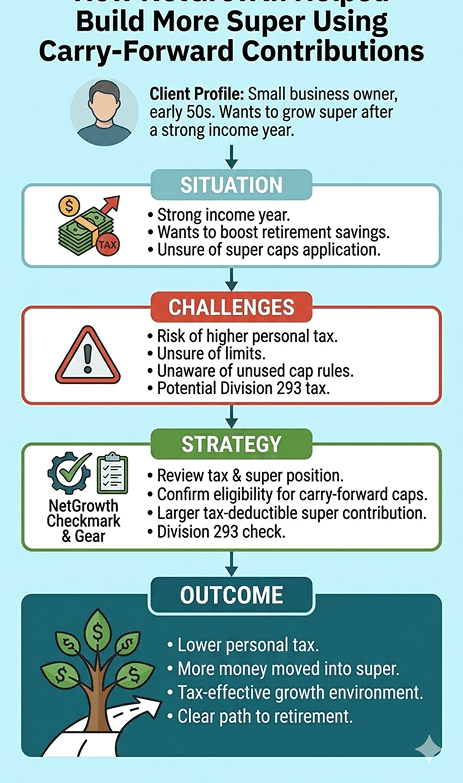
The Problem
A small business owner in their early 50s approached NetGrowth after a strong income year, looking to strengthen their retirement position. They were unsure how the updated superannuation caps and tax thresholds applied to them and wanted clarity on the best way forward.
Their higher-than-usual taxable income had triggered concerns about paying top marginal tax rates. They were also uncertain about the $30,000 concessional contributions cap and unaware of unused concessional cap amounts available under the five-year carry-forward rule. In addition, there was potential exposure to Division 293 tax due to income exceeding $250,000, and they did not have a clear retirement income strategy aligned with the $2 million transfer balance cap.
The NetGrowth Strategy
To address this, we conducted a full review of their retirement and tax position. We confirmed their total super balance was below $500,000 at 30 June, making them eligible to utilise carry-forward concessional caps. We then structured a significant tax-deductible personal contribution to reduce taxable income while staying within ATO contribution limits. We also modeled Division 293 implications to avoid unexpected tax liabilities and reviewed long-term retirement projections to ensure sustainability and compliance with pension phase limits.
The Results
As a result, the client reduced their personal income tax for the financial year and significantly increased their super balance within a 15% concessional tax environment. They also gained improved long-term retirement projections, along with greater clarity, compliance confidence, and a structured pathway toward earlier retirement.
Strategic Super Planning with NetGrowth
At NetGrowth, we simplify complex Australian superannuation rules into practical, tax-effective strategies that help clients protect and grow retirement wealth.
Visit us today to learn more about us: NetGrowth | Expert Financial Advice, Wealth Creation & Retirement Planning Australia